
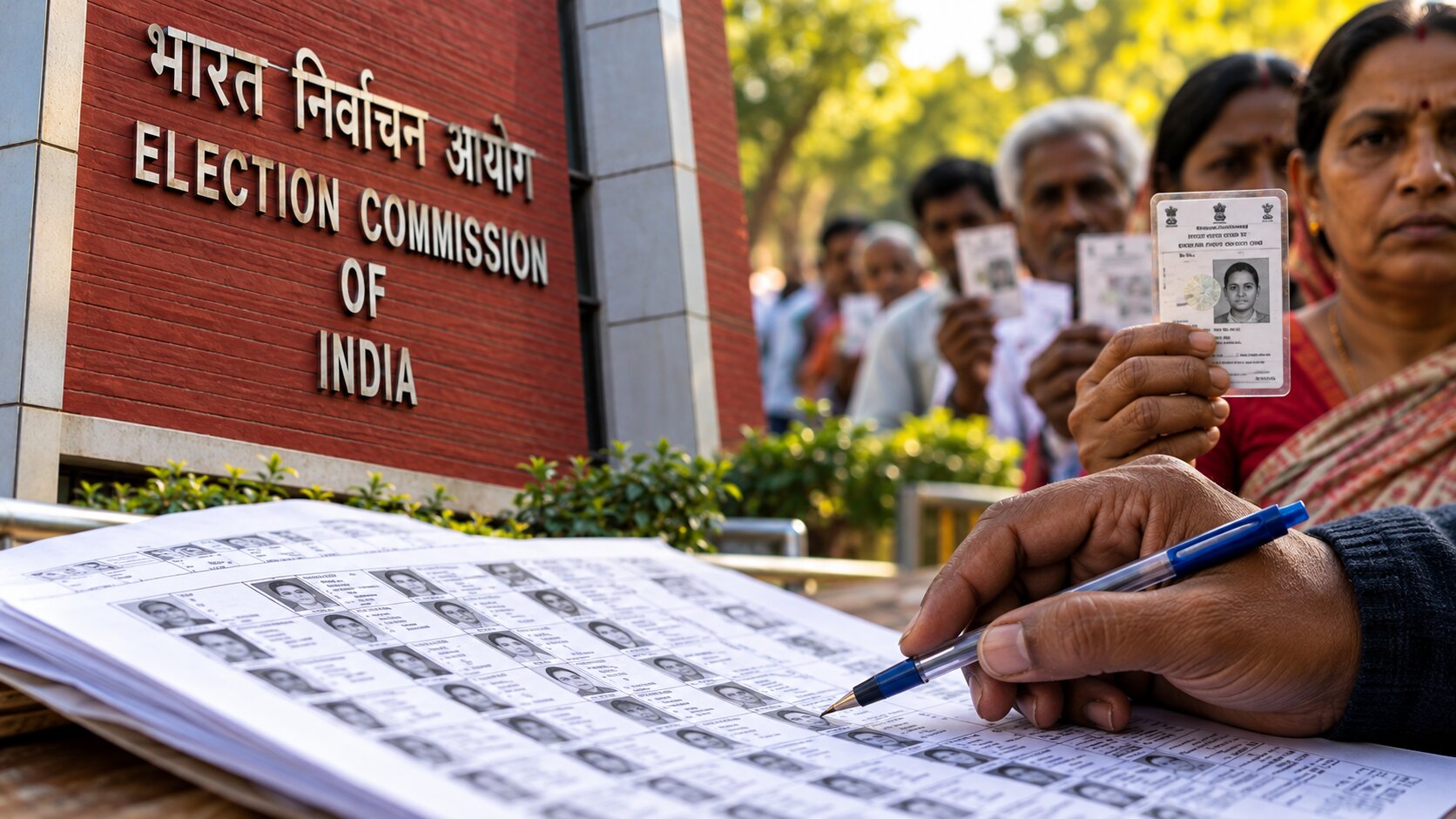
For some years, opposition parties have questioned the impartiality of the Election Commission of India. Blaming the Commission after a defeat is an old habit, and the charge alone proves little. This time, however, the strongest doubts have come from inside the Commission. They concern the Special Intensive Revision (SIR) of electoral rolls, the biggest overhaul of voter lists in decades. The Commission is a constitutional body, and under Article 324 it has the “superintendence, direction and control” of the preparation of electoral rolls. Article 326 guarantees adult suffrage. Its first duty is to protect every eligible citizen’s right to vote, and the questions now being asked are about whether it is meeting that duty.
What the commissioners objected to
On 23 September, The Indian Express reported that Election Commissioners Sukhbir Singh Sandhu and Vivek Joshi had put objections on record at least fourteen times over about ten months, addressed to Chief Election Commissioner Gyanesh Kumar [1]. According to the report, the objections covered voter registration, the deletion and restoration of names, changes to Form 6, and access to the electoral-roll database on the Commission’s ECINET platform. The commissioners also complained of decisions taken without their knowledge. One of Joshi’s objections reportedly said that for over a year he had received no agenda before Commission meetings and no minutes after them [2]. In July, both commissioners also wrote separately to the Cabinet Secretary about the distribution of work in the Commission’s IT set-up [3].
The Commission’s first response, on 23 September, was that differing views and written observations are a normal part of deliberation. Three days later, on 26 September, it issued Press Note No. ECI/PN/120/2026 after a meeting of all three commissioners, with a photograph of them together [4]. The note announced that agendas would be circulated in advance and minutes issued for every Commission meeting, and that officers’ foreign trips would need the Commission’s approval. It also said the letter to the Cabinet Secretary concerned the working of an officer on deputation and not any policy matter.
These steps are welcome, but they raise a question the note leaves unanswered. If circulating agendas and issuing minutes are now being announced as decisions, what was the practice before? The note also says nothing about the more serious complaint, which was that changes were made to a statutory form without the commissioners’ consent.
The Form 6 dispute
Form 6 is the form a citizen uses to apply for inclusion in the electoral roll. It is prescribed under the Registration of Electors Rules, 1960, which are made under the Representation of the People Act, 1950. According to the commissioners’ objections as reported, a declaration asking applicants about the previous SIR roll was added to the online Form 6 on ECINET without any amendment to the Rules. Joshi had raised the objection earlier, and Sandhu repeated it after the declaration appeared online [5].
In its 26 September note, the Commission said the declaration attached to Form 6 for the SIR had been upheld by the Supreme Court. On 5 October, Chief Justice Surya Kant, hearing petitions on the issue, said plainly that the court had not approved any modified Form 6 [6]. The Commission’s officials responded that Form 6 itself had not been changed and that only a declaration had been attached to it, a practice they said began with the Bihar SIR order of 24 June 2025 [7]. Legal commentators note that the declaration the court examined in its Bihar judgment was a simpler one, covering age, residence and citizenship [8]. The Commission has since reportedly removed the additional declaration from the online form in states where the SIR is complete.
The legal position is therefore as follows. The Commission has wide powers over electoral rolls, but a form prescribed by statutory rules is not something it can alter on its own authority. Whether attaching a declaration amounts to altering the form is now a live question before the court. Any answer will depend on documents the Commission has so far not made public.
What the Supreme Court has and has not held
An article like this one should state the law correctly, because the court’s May 2026 judgment is often misdescribed. On 27 May 2026, a bench of Chief Justice Surya Kant and Justice Joymalya Bagchi upheld the SIR in Bihar. It held that the exercise could be traced to Article 324 read with Section 21(3) of the Representation of the People Act, 1950, which allows a “special revision” of the rolls in exceptional circumstances. The court said it was distinct from ordinary revision, that it did not conflict with the Act or the 1960 Rules, and that it met the test of proportionality [9].
The petitioners had relied on Lal Babu Hussein v. Electoral Registration Officer (1995), which held that a person whose name is on the roll is presumed to be qualified and that natural justice must be followed before a name is deleted. The court did not overrule that judgment. It distinguished it, holding that the case concerned individual adjudicatory proceedings and not a systemic, inquisitorial exercise. It also held that the presumption attached to an existing entry is rebuttable and is not a perpetual guarantee against verification [10]. A summary of the judgment also records the court’s finding that the notice-and-hearing safeguards of the Rules were substantially preserved.
Critics argue that this reading takes too little account of how the exercise works in practice. They say a provision meant for exceptional revision has been used for a statewide one, and that voters already on the rolls have been made to prove their eligibility again. The court had earlier shown a different instinct. In August 2025, during the Bihar hearings, it directed the Commission to publish a booth-wise list of the roughly 65 lakh names left out of the draft roll [11], and it allowed excluded voters to file claims online with Aadhaar or any of eleven listed documents [12]. The Commission, for its part, has told the court that charges of mass disenfranchisement are “highly exaggerated” and that the SIR is necessary to keep the rolls pure [13]. A fair reading is that the court settled the Commission’s power to conduct an SIR but has not settled how that power was exercised in every state.
West Bengal: the appeals numbers
The Bengal figures come from the Commission’s own affidavits in the Supreme Court. Around 91 lakh names were removed from the state’s rolls ahead of the April 2026 Assembly elections: roughly 63 lakh at the draft stage and about 27 lakh declared ineligible after judicial officers examined some 60 lakh entries flagged for “logical discrepancies” [14]. The Supreme Court then required appellate tribunals to be set up, and 19 were constituted in March.
According to the Commission’s affidavit, 38,31,429 appeals have been filed. Of these, 22,21,118 were filed by voters whose names were deleted, and about 16.10 lakh challenge names that remain on the rolls [15]. Only 1,26,194 appeals, about 3.3 per cent, have been decided, and over 37 lakh remain pending. Of the decided appeals, 1,13,943, or just over 90 per cent, ended with the voter being added back [16]. Calculations based on the affidavit suggest that at the current pace the tribunals would need more than twelve years to clear the backlog [17]. The Commission has itself proposed increasing the number of tribunals so that they match the state’s parliamentary constituencies.
This should be read carefully. A 90 per cent restoration rate among decided appeals is a serious warning sign, and the earlier RTI figures, which showed a similar rate, point the same way [18]. But the decided appeals are a small share of the total, and the affidavits do not make clear how the decided cases divide between appeals seeking restoration and appeals challenging inclusion. It would be wrong to assume that nine in ten of the 27 lakh deletions were mistaken. What the data does show is that many eligible voters were removed in the first instance, and that the remedy is far too slow. People removed in 2026 may not be able to vote in the next election.
Delhi and the “logical discrepancy” problem
The third phase has brought the same concerns to Delhi. According to the petition before the Supreme Court, the draft roll published on 31 August carried 97.53 lakh electors, about 47.5 lakh were excluded, and 33.13 lakh voters on the draft roll received notices. Of these, 13.79 lakh were classed as unmapped and 19.33 lakh as having “logical discrepancies” [19]. The petitioners point out that the category is undefined. Analysts have reported that mismatches such as a parent’s name, or an age gap between parent and child of under 15 or over 50 years, trigger notices [20]. A logical discrepancy is not a finding that someone is ineligible, yet the voter must produce documents to stay on the roll.
Press analyses also report that in 24 of Delhi’s 70 constituencies the draft roll has fewer electors than the number of votes cast in the February 2025 Assembly election [20]. This does not by itself prove wrongful deletion, because a draft roll is not the final roll and claims and objections are still being heard. Some part of the gap may reflect duplicate entries or voters who have moved. Even so, the numbers are large enough to demand an explanation, and the Supreme Court has asked the Commission to justify the basis for these notices [21]. The Commission should publish its criteria and its constituency-wise reasons.
Who answers for the Commission?
The dispute has led to political demands. On 9 October, an INDIA bloc delegation met the President and submitted a memorandum seeking, among other things, the Chief Election Commissioner’s resignation and the repeal of the 2023 law’s immunity provision [22]. The legal route to removal is narrow. Under Article 324(5), the Chief Election Commissioner can be removed only in the same manner and on the same grounds as a Supreme Court judge. That means a motion in Parliament, while other commissioners can be removed only on the Chief Election Commissioner’s recommendation. Political demands are therefore unlikely to succeed without a parliamentary majority, which is why the question of how commissioners are appointed has become important.
The Chief Election Commissioner and Other Election Commissioners (Appointment, Conditions of Service and Term of Office) Act, 2023 provides for a selection committee made up of the Prime Minister, a Union Cabinet minister nominated by the Prime Minister, and the Leader of Opposition in the Lok Sabha. In practice the government commands two of the three votes. This replaced the arrangement the Supreme Court ordered in Anoop Baranwal v. Union of India (2023), under which the Chief Justice of India sat on the committee until Parliament legislated. When Gyanesh Kumar was appointed in February 2025, Rahul Gandhi recorded a note of dissent. Reform proposals therefore centre on a committee in which the executive does not hold a built-in majority.
What should happen now
The Commission’s own principle is that no eligible voter should be left out, and it should be tested by what the Commission does next. Four steps would go a long way:
-
It should publish the full record of its internal decisions on the SIR, including minutes, the objections recorded by its members and the orders on Form 6.
-
It should disclose the criteria for “logical discrepancies” and the reasons behind every notice.
-
It should enlarge the Bengal tribunals, as it has proposed, and report each month on appeals decided by type.
-
It should say plainly whether the statutory forms were altered and, if so, under what authority.
Being answerable to citizens is the Commission’s moral duty, and it is also what its constitutional mandate requires. Restoring credibility will take openness, and photographs of three commissioners sitting together will not do it.
References
-
The Indian Express investigation, 23 Sept 2026 (reporter Ritika Chopra); summarised at The Quint
-
Joshi’s 16 April objection: The Probe
-
Letters to the Cabinet Secretary: Deccan Herald
-
ECI Press Note No. ECI/PN/120/2026, 26.09.2026: Election Commission of India
-
Form 6 objections (same Deccan Herald explainer as note 3): Deccan Herald
-
CJI on Form 6, 5 Oct 2026: LiveLaw
-
ECI officials’ response: The Federal
-
Scroll explainer on Form 6: Scroll
-
Bihar SIR judgment, 27 May 2026: LiveLaw
-
On Lal Babu Hussein: The Print and Supreme Court Observer
-
Booth-wise list of 65 lakh names: Deccan Herald
-
Online claims with Aadhaar: The Tribune
-
ECI affidavit calling the charges “exaggerated”: The Tribune
-
Bengal removal figures: News on AIR
-
ECI affidavit, appeals breakdown: LiveLaw
-
Decided and restored appeals: NewsBytes
-
Twelve-year estimate (same NewsBytes report as note 16): NewsBytes
-
RTI figures: National Herald
-
Delhi petition figures: LiveLaw
-
Delhi analysis: The Wire
-
Supreme Court query on Delhi notices: Newslaundry
-
INDIA bloc memorandum, 9 Oct 2026: India TV
Disclaimer: This article is published as an opinion piece for public discussion and legal awareness. The views expressed are those of the author and do not necessarily reflect the views of Equality Times. The article should not be treated as legal advice.