
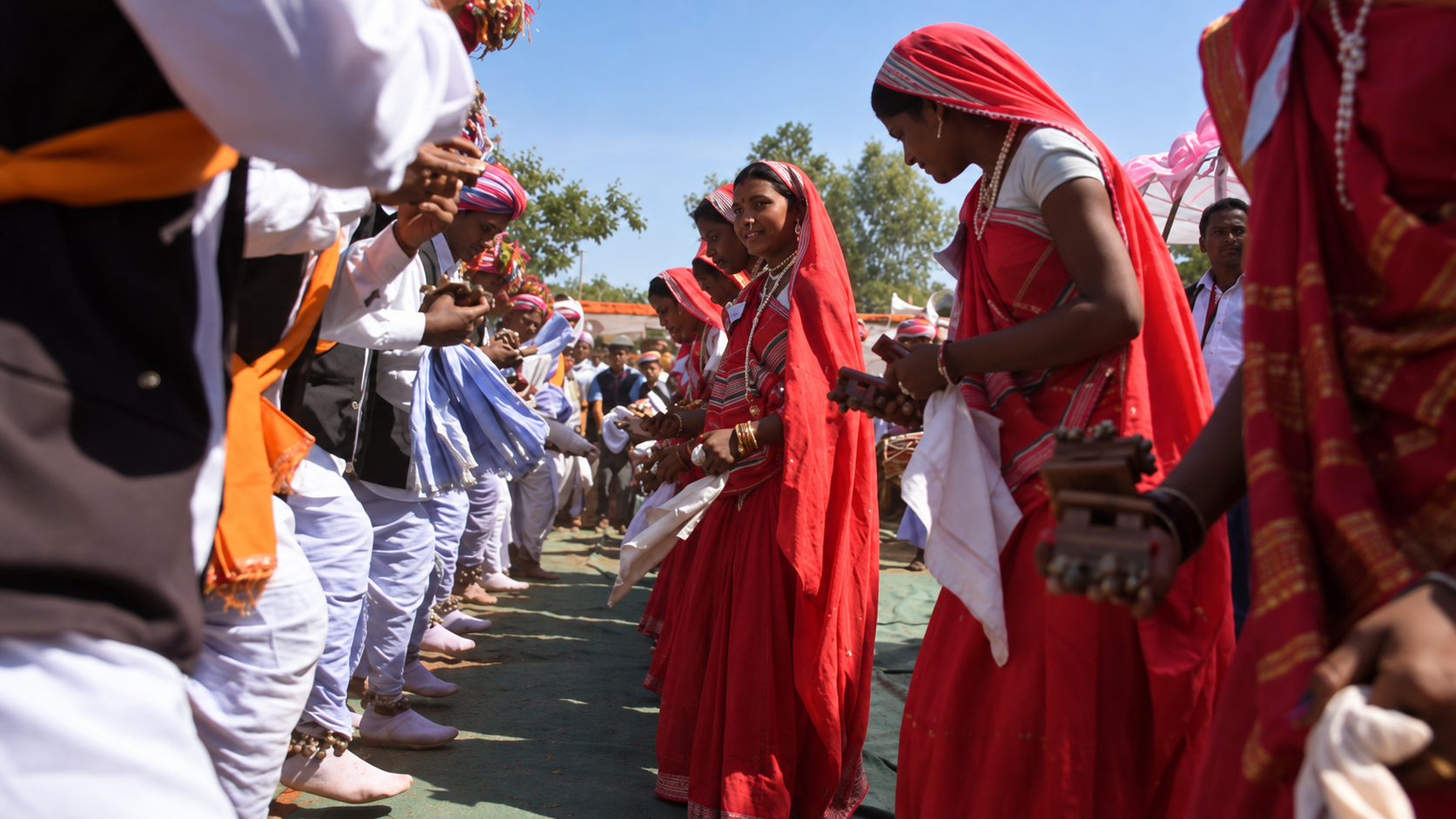
Melghat is often discussed through poverty, malnutrition, migration, forests and limited access to basic services. These realities deserve attention, but they do not tell the whole story. For communities living in a Scheduled Area, another question is equally important: who gets to decide about the land, forests and resources on which village life depends? That question is not merely administrative. Article 244 of the Constitution, read with the Fifth Schedule, provides a special framework for Scheduled Areas. The Panchayats (Extension to Scheduled Areas) Act, 1996 (PESA) introduced a framework for local self-governance in these areas, while the Forest Rights Act, 2006 (FRA) recognised individual and community forest rights and assigned an important role to the Gram Sabha in their determination. The law therefore recognises tribal communities not only as recipients of development programmes, but also as rights-holders with a role in decisions affecting their communities and resources. The more difficult question is whether that legal recognition becomes meaningful power at the village level.
The Law and the Village
The Gram Sabha occupies an important position in this legal framework. PESA was enacted to extend the Panchayati Raj system to Scheduled Areas while recognising the particular importance of village institutions. The FRA similarly places the Gram Sabha at the beginning of the process for determining forest rights. This is significant in a region such as Melghat, where forests are connected with livelihoods, customary practices, conservation and everyday life. The Supreme Court’s decision in Samatha v. State of Andhra Pradesh (1997) is also part of the broader constitutional jurisprudence concerning the protection of tribal communities and Scheduled Areas. The Court examined the protective purpose of the Fifth Schedule in relation to tribal land and economic interests. Taken together, these provisions and judicial developments reflect an important constitutional idea: tribal communities should have a meaningful role in matters affecting their lives and resources.
Yet the existence of a legal right does not necessarily make its exercise straightforward. A community seeking recognition of a forest right may have to understand the legislation, prepare evidence, participate in village-level processes and engage with administrative authorities. This is where the distinction between having a right and being able to use a right becomes important. The Forest Rights Act may provide the legal basis for a claim, but the practical value of that provision depends on whether communities can navigate the process through which recognition is obtained.
What Melghat’s Experience Shows
The publicly available work of KHOJ Melghat provides a useful record of some of these difficulties. Its annual reports describe efforts to build awareness about Community Forest Rights and work with village-level Forest Rights Committees. The 2011–12 report recorded difficulties concerning the recognition of community forest-rights claims and described participatory planning in villages including Payvihir, Lawada and Nayakheda. Such details are important because they show that implementation is not simply a matter of Parliament passing legislation. A statutory right has to be understood, claimed, documented and processed through institutions before it becomes a recognised right in practice. KHOJ’s public material also describes legal awareness work concerning the Forest Rights Act, PESA, MGNREGA and the Right to Information Act, together with efforts to strengthen Gram Sabhas and connect communities with government institutions and legal expertise.
Payvihir illustrates another stage of this process. According to documentation published by KHOJ and UNDP, the village received recognition of Community Forest Rights in 2012. The documentation describes subsequent work through the Gram Sabha involving forest and wildlife management, village planning, soil and water conservation, plantation, irrigation and other development activities. It also records the Gram Sabha’s role in mobilising resources for village development and states that Payvihir received the India Biodiversity Award in 2014. These particular achievements are reported in KHOJ’s documentation and are presented here as such. The importance of Payvihir is not that it should be treated as a perfect model for every village. Rather, it illustrates what can change when a community’s legal relationship with its forest is formally recognised: the Gram Sabha can become a platform for planning, conservation and engagement with government institutions rather than simply a forum for receiving decisions made elsewhere.
From Legal Recognition to Real Power
This is where the Melghat experience connects with the broader question of equality. Equality is often discussed in terms of whether the State treats people differently on prohibited grounds. But there is another practical question: do people have a realistic opportunity to use the rights that the law gives them? Two communities may possess the same statutory right while having very different access to information, documentation, officials or legal assistance. The wording of the law may be identical, while the ability to act upon it is not. This does not mean that every implementation difficulty automatically becomes a constitutional violation. It does mean that formal legal equality and practical access should not be treated as the same thing.
The role of organisations such as KHOJ is relevant in this context. Its publicly available material shows long-term work with communities around rights awareness, Gram Sabha strengthening and Community Forest Rights. Such work can help reduce the distance between legal institutions and communities that may otherwise find those institutions difficult to navigate. At the same time, civil society support cannot replace the responsibility of the State. The rights created by Parliament ultimately depend on public institutions processing claims, following statutory procedures and providing meaningful opportunities for participation and remedy. A system in which a community can exercise a legal right only when an intermediary is available to assist it would still leave an important access gap.
Melghat should therefore not be presented simply as either a success story or a story of failure. The available documentation shows difficulties in securing recognition alongside examples of communities using recognised rights in relation to conservation, livelihoods and local planning. That complexity is precisely what makes the region worth examining through a legal lens. PESA and the Forest Rights Act provide a framework for participation and community rights, but their value depends on what happens after the legislation is enacted.
The larger question is simple but important: what does it really mean to say that a community has a right? If the answer ends with a provision in a statute, the analysis is incomplete. A meaningful right requires a practical path through which the people who hold it can understand it, claim it and use it. In Melghat, the distance between legal recognition and the ability to exercise that recognition is where the deeper question of equality begins.
A legal right is important. But its real value begins when the people who hold it can actually use it.
References
- Constitution of India, Article 244 and Fifth Schedule.
- The Panchayats (Extension to Scheduled Areas) Act, 1996.
- The Scheduled Tribes and Other Traditional Forest Dwellers (Recognition of Forest Rights) Act, 2006.
- The Maharashtra Village Panchayats Act, 1959.
- Samatha v. State of Andhra Pradesh, (1997) 8 SCC 191.
- KHOJ Melghat, Annual Report 2010–11.
- KHOJ Melghat, Annual Report 2011–12.
- KHOJ Melghat & UNDP, documentation concerning Payvihir and Community Forest Rights.
- KHOJ Melghat, public material on legal awareness, Gram Sabha strengthening and Community Forest Rights.
Disclaimer: This article is intended for legal education and public-interest discussion and does not constitute legal advice. The views expressed are those of the author and do not necessarily represent the views of KHOJ Melghat or any other organisation referred to in the article.