
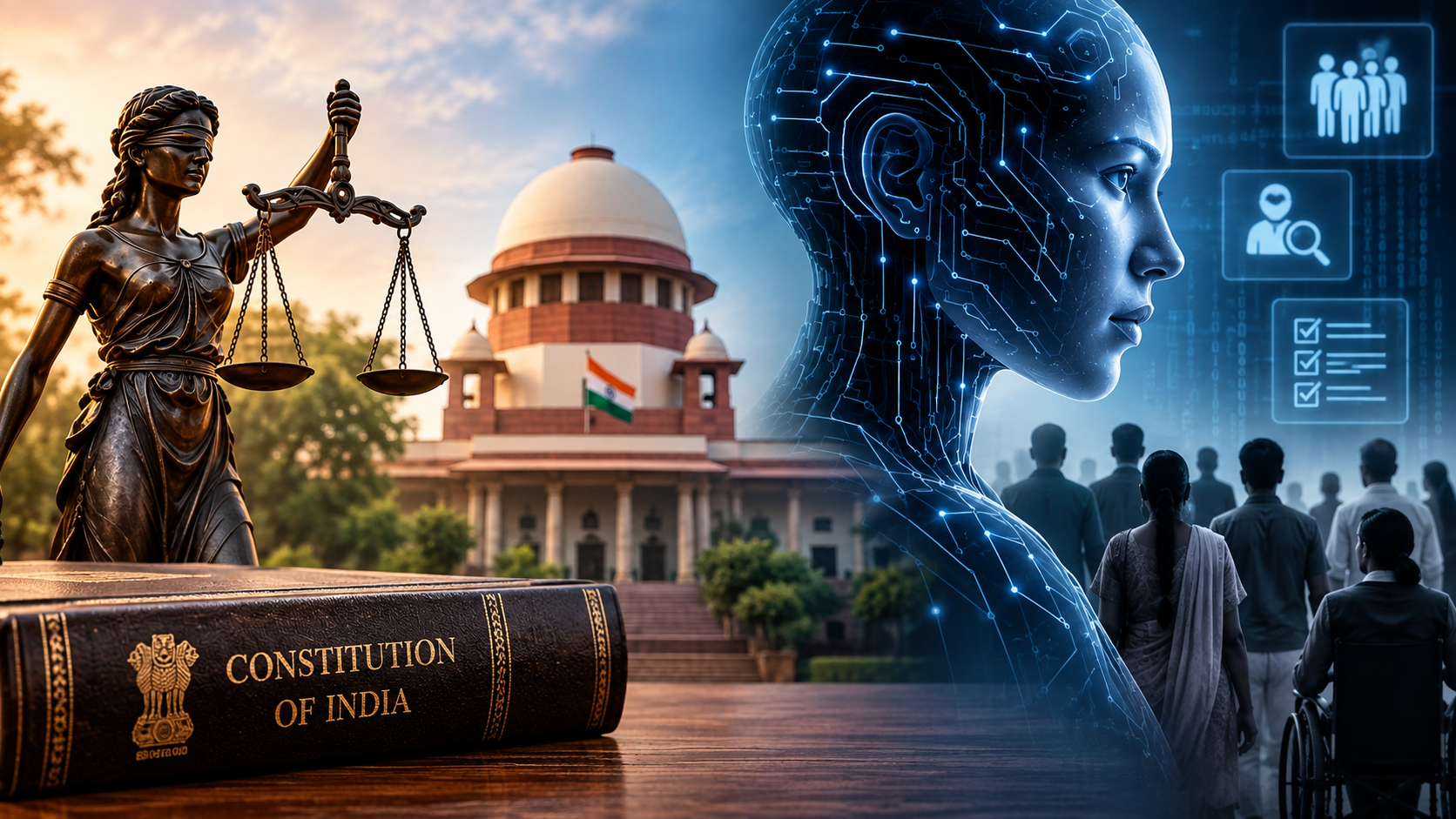
As artificial intelligence becomes part of administration, employment, public services and decision-making, a constitutional question is becoming increasingly important: when an automated system produces unequal outcomes, who remains responsible?
Artificial intelligence is increasingly moving from laboratories and private technology platforms into areas that directly affect people’s lives. Governments and institutions are exploring AI for public-service delivery, administrative decision-making, welfare systems, recruitment, surveillance and other forms of governance. India’s IndiaAI Mission reflects the scale of this transition, with the Government seeking to develop national AI infrastructure while also emphasising safe and trusted AI.
The constitutional difficulty is not simply whether an algorithm is technically accurate. It is whether the use of such systems remains consistent with constitutional principles when decisions affect rights, opportunities or access to public benefits.
The Indian Constitution does not contain a provision specifically written for artificial intelligence. Yet that does not place AI outside constitutional scrutiny. Articles 14 and 15 already impose requirements of equality and non-discrimination on State action. The challenge is to understand how those guarantees operate when the decision-making process is partly or substantially automated.
The central concern is straightforward: an algorithm may be neutral in its instructions while producing unequal consequences because of the data, assumptions or proxies built into the system. That possibility becomes particularly important in India, where social and economic inequalities have developed over generations.
Equality Beyond the Written Rule
Article 14 guarantees equality before the law and equal protection of the laws. Indian constitutional jurisprudence has progressively moved beyond a narrow understanding of equality as merely treating everyone identically. The Supreme Court’s decision in E.P. Royappa v. State of Tamil Nadu is an important part of this development, with arbitrariness in State action becoming closely connected with the constitutional guarantee of equality. The Court has subsequently reiterated that State action cannot be arbitrary and must satisfy requirements of fairness and reason.
The significance of this principle becomes clearer when applied to automated decision-making.
Suppose a public authority introduces an algorithm to identify beneficiaries for a welfare programme. The system may process thousands of applications more quickly than human officials. But speed does not answer the constitutional question. The relevant questions include: What data is being used? Which factors influence the result? How was the system designed? Can an individual challenge an incorrect decision? Is there meaningful human review? Can the authority explain why a person was excluded?
An automated decision is still a decision. If the State uses technology to exercise public power, the constitutional limits applicable to that power do not disappear merely because software is involved.
This is particularly important because the apparent objectivity of a computer-generated result can make discrimination harder to identify. A decision produced by a mathematical model may appear neutral even when the underlying data reflects existing social inequalities.
Article 15 and the Problem of Indirect Discrimination
Article 15(1) prohibits the State from discriminating against citizens on specified grounds including religion, race, caste, sex and place of birth. The Constitution also permits particular forms of affirmative action through provisions such as Articles 15(3) and 15(4).
Artificial intelligence creates a more complicated problem because a system does not necessarily have to use an explicitly prohibited characteristic to produce unequal effects.
Consider a hypothetical recruitment system that does not ask an applicant’s caste. If it nevertheless relies heavily on variables that correlate with caste because of historical inequalities—such as particular educational institutions, geographical location or other socioeconomic indicators—the system may reproduce patterns of exclusion without directly asking the prohibited question.
This is commonly described as proxy discrimination: a variable that appears neutral may function as an indirect substitute for a protected characteristic.
The existence of such a proxy does not automatically establish a constitutional violation. The legal assessment would depend on the nature of the State action, the classification or distinction involved, its purpose and justification, its actual impact, and the safeguards available to affected individuals. But the possibility demonstrates why conventional assumptions about neutrality are insufficient when automated systems are used in public decision-making.
The problem is especially significant in India because data is not produced in a social vacuum. Historical patterns of caste, gender, region, education, income and access to resources can influence the datasets from which automated systems learn.
When Historical Inequality Enters the Dataset
AI systems are dependent on data. A system trained on historical information may identify patterns in that information and use them to make predictions or classifications.
That becomes problematic when historical patterns themselves reflect unequal opportunities.
A recruitment system, for example, may be trained on previous hiring decisions. If previous decisions consistently favoured one group, the system may learn characteristics associated with those decisions and treat them as indicators of future suitability. The resulting system could therefore reproduce the past while appearing to make an independent technological assessment.
A widely reported example outside India involved Amazon’s experimental recruitment tool, which was reported to have disadvantaged women because it learned patterns from historical recruitment data. The example does not establish an Indian constitutional violation, but it illustrates a broader technological problem: historical data can carry historical preferences into automated decision-making. The original research paper uses this example to demonstrate how apparently neutral systems can reproduce patterns embedded in their training data.
The lesson for India is not that every AI system will discriminate. Rather, it is that accuracy and equality are separate questions.
A model can accurately reproduce patterns in its dataset and still reproduce an unequal social structure.
This distinction matters greatly in public administration. If an automated system is used to determine access to employment, welfare, education or other State-supported opportunities, efficiency cannot be the only measure by which it is evaluated.
The Problem of Opacity
Another difficulty is transparency.
Many AI systems can be difficult for ordinary individuals to understand. Even where an institution knows which data points are considered, the relationship between those inputs and the final outcome may not be obvious to the person affected.
This creates a serious procedural concern. A person who is denied a benefit or opportunity needs more than the information that “the system rejected the application.” They may need to know what decision was made, why it was made, whether the information used was accurate, and how the decision can be challenged.
The constitutional importance of procedural fairness becomes greater when automated decisions affect fundamental rights or important public benefits.
Human review therefore cannot be reduced to a person merely pressing an approval button after an algorithm has produced a result. Meaningful oversight requires the authority to understand the basis of the decision sufficiently to question, correct or reject it where necessary.
The original research paper similarly identifies transparency, human supervision, regular evaluation and accountability as necessary safeguards when AI is used in administrative decision-making.
Equality, Privacy and Personal Data
The equality question is closely connected with privacy.
AI systems often depend on large quantities of information about individuals. The constitutional recognition of privacy in Justice K.S. Puttaswamy (Retd.) v. Union of India established privacy as a fundamental right and emphasised principles including legality, legitimate State aim and proportionality in assessing restrictions.
This matters because a system may make increasingly consequential inferences from information that an individual did not understand would be used for that purpose.
India has also enacted the Digital Personal Data Protection Act, 2023, which establishes a statutory framework concerning the processing of digital personal data. The Act recognises concepts including automated processing, data fiduciaries and data principals, and provides for obligations and rights within its statutory framework.
Data protection and equality are not identical constitutional questions. Yet they can intersect. The collection and processing of personal information may influence how individuals are classified, assessed or treated. For that reason, responsible AI governance cannot consider data protection, privacy and equality as completely separate concerns.
Constitutional Accountability Cannot Be Automated
The most important principle is perhaps the simplest: delegating a decision to technology does not mean delegating constitutional responsibility.
When a public authority uses an automated system, responsibility ultimately remains with the institution exercising public power. An algorithm cannot appear before a court to explain why a citizen was denied a benefit. It cannot bear constitutional responsibility for an arbitrary classification. Those responsibilities remain with the human and institutional actors who designed, procured, deployed and relied upon the system.
This does not mean that AI should be excluded from governance. Properly designed systems may improve efficiency, identify patterns and help public authorities manage large volumes of information. The question is not whether technology should be used, but under what conditions its use remains compatible with constitutional government.
At a minimum, high-impact public-sector AI systems require mechanisms for meaningful human oversight, testing for discriminatory effects, documentation of important decisions, appropriate transparency, avenues for correction and review, and clear institutional responsibility.
Regular evaluation is equally important. A system that performs fairly when introduced may produce different results as its data, users or operating environment changes. Accountability must therefore continue throughout the life of the system rather than ending when the software is deployed.
India’s AI Future and the Equality Question
India is building significant national capacity around artificial intelligence. The IndiaAI Mission has been organised around areas including computing infrastructure, datasets, foundation models, future skills, innovation and start-up development, and safe and trusted AI. Official IndiaAI material describes the mission as seeking an inclusive and future-ready AI ecosystem.
This development makes constitutional questions increasingly practical rather than theoretical.
As AI becomes part of public administration, the important question will not simply be whether India can build powerful systems. It will also be whether those systems operate within the constitutional framework.
The Constitution was designed to place limits on public power. Technological advancement does not alter that basic principle. If anything, increasingly complex systems make accountability more important because the consequences of a decision may become harder for an ordinary person to understand or challenge.
India’s constitutional commitment to equality therefore has to be considered not only at the level of legislation and administrative rules, but also at the level of the technologies through which those rules are implemented.
Conclusion
Artificial intelligence can transform the way governments and institutions make decisions. But efficiency is not a substitute for equality, and automation is not a substitute for accountability.
Articles 14 and 15 provide an existing constitutional framework through which discriminatory or arbitrary State action can be examined. The challenge posed by AI is that inequality may sometimes emerge indirectly—from historical datasets, proxy variables, system design or insufficient opportunities for human review—rather than from an openly discriminatory rule. The original research paper identifies precisely this concern: social inequalities contained in data can be reproduced through automated systems if they are not adequately examined.
The appropriate response is not to treat every algorithmic difference as unconstitutional. It is to ensure that automated decision-making remains open to constitutional scrutiny.
An AI system may process the data. It may identify a pattern. It may even recommend a decision.
But where public power is involved, the constitutional responsibility remains human.
Notes
- Constitution of India, arts. 14 and 15.
- E.P. Royappa v. State of Tamil Nadu, (1974) 4 SCC 3.
- Maneka Gandhi v. Union of India, (1978) 1 SCC 248.
- Justice K.S. Puttaswamy (Retd.) v. Union of India, (2017) 10 SCC 1.
- Government of India, IndiaAI Mission, Ministry of Electronics and Information Technology.
- Digital Personal Data Protection Act, 2023, Act No. 22 of 2023.
- Jeffrey Dastin, Reuters, reporting on Amazon’s experimental AI recruitment tool and its treatment of women applicants, 2018.
- Cathy O’Neil, Weapons of Math Destruction: How Big Data Increases Inequality and Threatens Democracy (Crown, 2016).
- UN Human Rights Council, The Right to Privacy in the Digital Age, A/HRC/48/31 (2021).
Selected Bibliography
Constitution of India.
E.P. Royappa v. State of Tamil Nadu, (1974) 4 SCC 3.
Maneka Gandhi v. Union of India, (1978) 1 SCC 248.
Justice K.S. Puttaswamy (Retd.) v. Union of India, (2017) 10 SCC 1.
Digital Personal Data Protection Act, 2023.
Ministry of Electronics and Information Technology, Government of India, IndiaAI Mission.
NITI Aayog, National Strategy for Artificial Intelligence (2018).
Cathy O’Neil, Weapons of Math Destruction: How Big Data Increases Inequality and Threatens Democracy (Crown, 2016).
Disclaimer
This article is intended for legal education and general informational purposes. It does not constitute legal advice and should not be treated as a substitute for professional legal consultation.